GPhC-registered pharmacies · London & Nottingham | Free UK delivery: eligible orders £50+; selected items £60+ | Find your branch



Only 2 left in stock
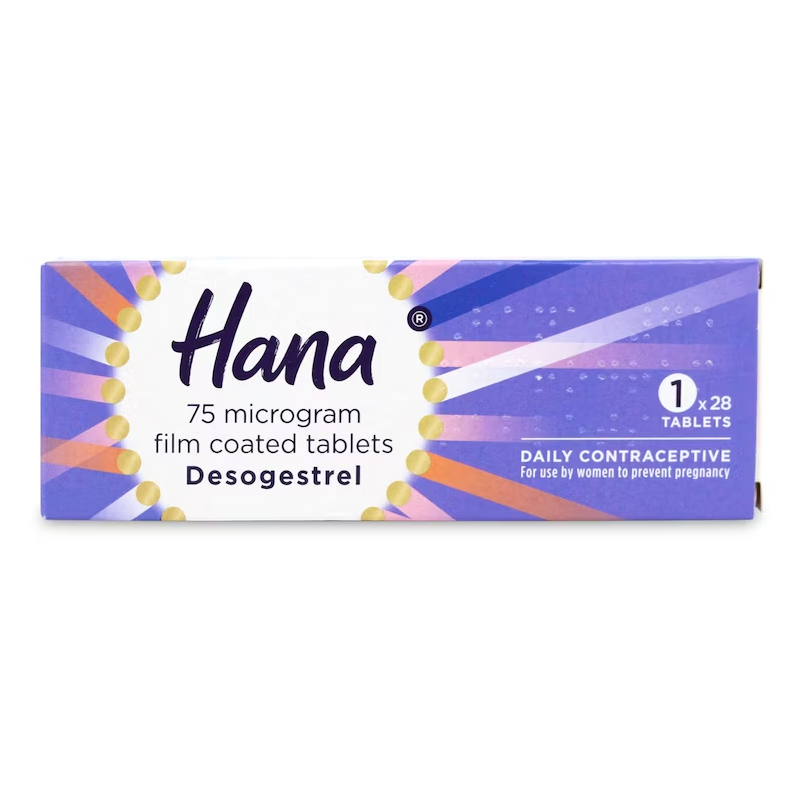
Hana 75 Microgram Film-Coated Tablets (Desogestrel) – 28 or 84 Tablets
SKU WY0033448S

Hana is a daily oral contraceptive used to prevent pregnancy in women of childbearing age. Each tablet contains 75 micrograms of desogestrel, a progestogen, and no oestrogen, so it is a progestogen-only pill (POP). It can be supplied without a prescription only after a pharmacist has checked that it is suitable for you. Packs of 28 or 84 tablets, sold by Ways Pharmacy (UK).
This is a pharmacy (P) medicine sold under the supervision of our GPhC-registered pharmacist. You may be asked a few short questions before your order is supplied.
Key facts
| Active ingredient | Desogestrel 75 micrograms per film-coated tablet |
|---|---|
| Type | Progestogen-only contraceptive pill (POP); contains no oestrogen |
| Use | A daily contraceptive used to prevent pregnancy for women of childbearing age |
| How it works | Primarily by preventing ovulation; it also thickens cervical mucus, making it harder for sperm to enter the womb |
| Dose | One tablet at the same time every day, with no break between packs |
| Missed pill | Less than 12 hours late: take it straight away and you are still protected. More than 12 hours late: take it straight away and use extra contraception for the next 7 days |
| Age | Women of childbearing age. No clinical data on efficacy and safety are available in adolescents below 18 years |
| Contains | Lactose monohydrate |
| Pack | 28 tablets (1 blister) or 84 tablets (3 blisters); each blister is packed in a foil sachet |
Who it is for
- Women of childbearing age who want a daily contraceptive pill to prevent pregnancy.
- Women who cannot take oestrogens or do not want to.
- Women who are breast-feeding.
Not suitable for: Do not take Hana if you have a cancer that is affected by sex-steroid hormones, such as certain types of breast cancer, ovarian cancer or endometrial (uterine) cancer; if you have a blood clot in the legs (deep vein thrombosis) or lungs (pulmonary embolism); if you have, or have had, jaundice or severe liver disease and your liver blood tests have not returned to normal; if you have unexplained vaginal bleeding between periods or repeated bleeding after sex; if you are allergic to desogestrel or any of the other ingredients; or if you are pregnant or think you may be. Talk to a pharmacist, doctor or family planning nurse first if you have ever had breast or another hormone-sensitive cancer or a blood clot, or if you have liver problems, high blood pressure, diabetes, epilepsy, tuberculosis or have had chloasma. Some medicines and herbal remedies can stop Hana working properly, including some treatments for epilepsy, tuberculosis and HIV, bosentan, griseofulvin and St John's Wort: tell the pharmacist about everything you take.
How to use
- Read the label and Patient Information Leaflet (PIL) before use.
- Take one tablet at the same time every day and swallow it whole. Take the tablet marked with the correct day of the week and follow the arrows on the pack.
- When a pack is empty, start a new pack the next day, without a break and without waiting for a bleed.
- If you are not currently using hormonal contraception, start on day 1 of your period and no extra contraception is needed. If you start on days 2–5, use extra contraception such as condoms for the first 7 days.
- If you are more than 12 hours late, take the most recently missed tablet straight away, leave any earlier missed tablets, carry on as usual and use extra contraception for the next 7 days.
- If you vomit within 3–4 hours of taking a tablet, or have severe diarrhoea, treat it as a missed pill and follow the missed-pill advice in the leaflet.
Frequently asked questions
What should I do if I forget to take Hana?
If you are less than 12 hours late, take the delayed tablet straight away and take the next ones as usual; you are still protected. If you are more than 12 hours late, take the most recently missed tablet straight away, carry on as usual and use extra contraception such as condoms for the next 7 days. If you missed tablets in the first week and had sex in the week before, ask a pharmacist for advice.
Will Hana change my periods?
It is common to have bleeding patterns that differ from your usual periods. Bleeding may be more or less frequent, lighter or heavier, or may stop altogether. Keep taking Hana every day, and see a doctor or family planning nurse if bleeding is unusually heavy or repeatedly brought on by sex.
Can I take Hana while breast-feeding?
Yes. Hana may be used while you are breast-feeding. A small amount of desogestrel passes into the milk.
Does Hana protect against sexually transmitted infections?
No. Hormonal contraceptives do not protect against HIV or other sexually transmitted infections. Only condoms can do that.
Can Hana be used as emergency contraception?
No. Hana does not work as an emergency contraceptive. If you have used emergency contraception containing ulipristal acetate, wait 5 days before starting Hana and use condoms during that time and for the first 7 days of taking Hana.
What are the common side effects?
Common side effects, which may affect up to 1 in 10 women, include altered or depressed mood, headache, nausea, acne, decreased sexual drive, irregular or no periods, breast pain and increased body weight.
Safety and storage
- Contact a doctor immediately if you have severe pain or swelling in a leg, unexplained chest pain, breathlessness or cough up blood; sudden or severe pain in the lower abdomen; or sudden severe stomach ache or yellowing of the skin or eyes.
- See a doctor as soon as possible if you feel a lump or notice changes in your breast, or if you have mood changes or depressive symptoms.
- Keep having regular cervical screening while you take Hana.
- Do not store above 30°C. Use within 3 months of first opening the sachet.
- Keep out of the sight and reach of children.
- Read the PIL. Report suspected side effects through the MHRA Yellow Card scheme.
This is a medicine. Always read the label and the Patient Information Leaflet before use. If symptoms persist, speak to a pharmacist or doctor.
Related products


Pharmacist-led care · English & 中文
Free UK delivery: eligible orders £50+; selected items £60+